Sunday, May 21, 2006

Conflagration


It can start in such an insignificant manner. A campfire not properly extinguished. A tossed out butt from a cigarette. A single lightning strike. Even a broken piece of glass in the sunlight. Every year tens of thousands of acres of forest are lost to carelessness. While this is an ecological issue that can endanger the lives of local citizens and wildlife the damage it causes is temporal. There is an greater danger of conflagration that can happen. It is a spiritual fire. One that can destroy a family, church, and/or community.

James tells us, 'How great a fire is set ablaze by such a small fire! The tongue is a fire, a world of unrighteousness. The tongue is set among our members, staining the whole body, setting on fire the entire course of life, and set on fire by hell itself.' Think about that: the putrid sulphurous flame of hell within our own bodies.

Such calamity and destruction normally begins in a small manner. An unkind word, a taunting jest, a critical look each of these can be the spark that in time results in a full blown conflagration - devouring everything in its path. Just as a forest fire can, given enough size, and topographical conditions develop its own wind drafts to move itself along; so can the fire of destruction in a family or congregation. At those times it is impossible to stop apart from the work of the Holy Spirit among us.

How many families have been destroyed by a careless word? How many congregations have split because of a selfish comment? Christians living in community must guard their tongues. Else, we perish.

Sunday, May 14, 2006

Sunday Musings


Today many across the nation, and several other countries celebrated Mother's Day. In our worship service this morning we focussed upon the role of the mother in the Godly home. Sadly, this role stands in stark contrast to much of what is presented to Christians in modern life. Motherhood is taking it on the chin in our culture. Its significance is downplayed. Its honour has been downgraded.

Many young women today do not even consider motherhood. It is not even in the realm or reason for them as they grow. (Note I did not write 'mature'.) This is tragic. The mother's role in the home is more than merely biological. The Scriptures show us that the mother is to work alongside the father to bring instruction, law, discipline, and ultimately wisdom to their children. This is ignored by many, if not most, today.

Children are not born little blank slates. The Scriptures teach us that we are born in sin. That the guilt of Adam is ours as well. The mother is to work with the father, in the power of the Spirit, using the tools at her disposal to drive the inborn foolishness from a child and prepare it to receive wisdom from above. This is tough work. This is vital work. This is work that is being skipped by far too many parents, Christian parents, today. Is it any wonder that we have a bunch of 20 and 30 somethings wandering aimlessly through life?

Training children to be godly adults is a monumental task. At times it can appear to be overwhelming. But, rest assured. The God of heaven stands ready with his powerful grace to accomplish his purposes through parents.

Mothers, you're necessary, needed, and wonderful.

Sunday, April 16, 2006

The end of the 45


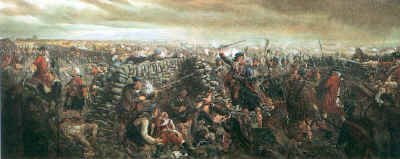
No, this is not a post about the passing of a well loved calibre of firearm. In the year 1746 on this date a pivotal battle was fought on a moor in Eastern Scotland. The place's name still rings in the ears of Scots and those of Scottish lineage: Culloden.

Bonnie Prince Charlie Stuart and his Highland army met one of the strongest armies of the world on the moor enroute, from the east, to Inverness. His goal to reclaim the throne of England from the Hanoverian George II. Why does such a moment in time still move the hearts of men today? For varied reasons. For the Scot it is the bravery of the clansmen: the valiant effort after a long march, a day and one half without sleep and two days without rations. And, it is the memory of the aftermath of Culloden. The English army under general orders massacred every known survivor. The redcoat soldiers relentlessly hunted down any one in anyway connected with the battle and brutally murdered them. The story is too graphic to detail here. Additionally, after the battle for all intents it became illegal to be a Scot. Speaking Gaelic, wearing the tartan, the pipes, and many other activities became illegal. It was an attempt to wipe out a culture. Did it work? Hardly.

So, you may ask, why write about something so long ago? What bearing does it have upon anything today? Good questions. Aside from the Highland blood that flows through my veins there is another reason. We can learn from the rough-hewn Highlanders. They knew that they were headed to battle against a larger, better equipped, professional army. Yet, they still fought. Why? The believed in the cause.

Christian, do you believe in the Cause? Many will say, 'Yes, obviously I believe. I am a Christian.' But, will you battle when the odds are obviously stacked against you? Will you march with your Lord into what, from your vantage point, appears to be sheer insanity?

In this life we must fight. We've already been promised the victory and yet so many cower.

Saturday, April 15, 2006

Resurrection!


Many Christians will set aside tomorrow as a special day in which to celebrate the resurrection of our Lord, Jesus Christ. Why this day? There are many people who will argue for varied reasons that we should not celebrate this day. In reality each day is a celebration of the resurrection of Christ. However, celebrating that first day of the week following Passover is a special recognition that Jesus is the eternal Passover sacrifice. Hearkening back to the Exodus, God's great deliverance of his people Israel from Egyptian bondage, the Passover prophecies the deliverance of God's elect, the church, from the bondage of death. Why not celebrate that!

Christ's sacrifice at Golgotha is the pivotal point in God's eternal plan of redemption. His atonement for the elect is an incredible action. Why would Holy God die for sinful man? At the baseline of the answer is that it brings him great glory. Many today say that the sacrifice of Christ was to ransom men from the realm of Satan. Ridiculous! Satan has no power over the actions of God. He is a created being. His hands are bound by God. (Just read Job and see.) No, the sacrifice of Christ was to appease the just wrath of a holy God.

The following prayer comes from 'The Valley of Vision', published by Banner of Truth. In a very poignant fashion it brings to bear the reality and result of the ressurection of our Lord.

O God of my Exodus
Great was the joy of Israel's son,
when Egypt died upon the shore,
far greater the joy
when the Redeemer's foe lay crushed in the dust.

Jesus strides forth as the victor,
conqueror of death, hell and all opposing might;
He bursts the bands of death,
tramples the powers of darkness down,
lives for ever.
He my gracious surety,
apprehened for payment of my debt,
comes forth from the prison house of the grave
free, and triumphant over sin, Satan, and death.
Show me herein the proof that his vicarious offering
is accepted,
that the claims of justice are satisfied,
that the devil's sceptre is shivered,
that the wrongful thron is levelled.
Give me the assurance that in Christ I died,
in him I rose,
in his life I live, in his victory I triumph,
in his acension I shall be glorified.
Adorable Redeemer,
thou who wast lifted up upon a cross.
art ascended to the highest heaven.
Thou, who as man of sorrows
wast crowned with thorns,
art now as Lord of life wreathed with glory.
Once, no shame more deep than thine,
no agony more bitter,
no death more cruel.
Now, no exaltation more high,
no life more glorious,
no advocate more effective.
Thou are in the triumph car leading captive
thine enemies behind thee.
What more could be done than thou hast done!
Thy death is my life,
thy resurrection my peace,
thy ascension my hope,
thy prayers my comfort.


Sunday, April 09, 2006

A Convicting Awareness

A couple of days ago I took one of those quirky online polls. The purpose of this poll was to check one's congruency to Scottish Theologians. (Thanks to fatbapist for the poll. His link's on the left.) I scored 95% in alignment with Thomas Boston. I've admired Boston ever since learning of him and was somewhat amused by the score. Then 'this morning' happened. Context: I awoke from a dream in which I was tiring of the pastorate. I did my usual morning blog check and on Dr. George Grant's excellent blog read the following.

Thomas Boston
Born in 1676 in the obscure village of Duns, Berwickshire, Thomas Boston died on this day in 1732 in the equally obscure parish of Ettrick in the Scottish Borders. But his 56 years of life, 45 of them spent in conscious Christian discipleship, lend credibility to the spiritual principle that it is not where a Christian serves, but what quality of service he renders, that really counts.

Graduating with a degree in the classical arts from Edinburgh University, Boston was able to afford only one session of theological training. He then underwent a rigorous self-guided study program completing all his studies extramurally. With arduous discipline, sustained by only a meager library, his autodidactic studies earned him a widespread reputation. Indeed, as a Hebrew scholar he was, according to the renowned linguist George Morrison, 'welcomed as an equal by the finest Hebrew scholars in the world.' As a theologian, Jonathan Edwards wrote that he was 'a truly great divine.'

But it was as a loving, faithful, rigorously self-disciplined Christian pastor, and one deeply committed to the grace of God, that Boston was best remembered. Leaving his first charge at Simprin, where he served 1699-1707, he settled in Ettrick for a 25-year ministry that saw the numbers of communicants rise from a mere 60 in 1710 to nearly 800 in 1731.

Constantly burdened for his congregation, Boston taught them in season and out of season, in pulpit and at home. Burdened for the truth of the Gospel, he overcame all natural timidity to engage in confronting heretical doctrine and dealing with the critical cultural issues of the day. Though he was a quiet man, by all accounts he became a roaring lion in the pulpit. According to James Heatherton, 'There was a grip in it that no preacher wins who is a stranger to his own heart.'

He was thus counted as one of the most powerful and effective ministers of his day-and this despite the fact that he labored for Christ in an obscure, out of the way place all his life, never desiring for anything more. According to Thomas Chalmers, 'He so understood the covenant that he found his greatest reward amongst those who knew him best; so he never desired to leave them.'


As I read this I became more and more convicted of just how far short I fall from such a wonderful example as Thomas Boston. Some of our theological leanings may be the same, but my life is markedly different from him. The tireless dedication he exhibited to the preaching of the gospel and the loving of his congregation are an inspiration and indictment. By the time I finished my eyes were full of tears.

My God give me the grace and ability to serve as such a faithful man.

Thursday, March 30, 2006

Unabated Activity


The frenetic pace of life has continued unababted. Yet, in this time precious lessons are learned. Primarily: SLOW DOWN! As Americans we seem to be enamoured of the fast, the furious, and the frequent. We have fast food, fast cars, fast medicines, fast everything. Out of my own musings I hope to share a message that I need to relearn myself. Enjoy this marvelous creation that God has made. Faithfulness, not exhaustion is the mark of a true disciple of Christ. May God find us faithful with enough energy to serve those whom he entrusts to us.

I find a great deal of symbolism in the picture I've posted. I took this while driving down a busy road. In the foreground and on the ground you can see the normal hubbub of life. People driving like mad men. Yet, lift your eyes and behold the beauty of heaven.

Monday, January 30, 2006

Reformers on Islam and Mohammed

To hear some Christians speak one would think that dealing with Islam and its violence is a distinctly modern task. This is not the case. A good study of Church history will reveal a great deal of discussion about Islam and its founder Mohammed. The reformers Calvin and Luther were not silent on this topic. A hearty, 'Thank You!' to Dr. George Grant for his permission to quote the article below. It is from his worthy blog, Grantian Florilegium. (Linked in the left side bar.)

Luther and Calvin on Islam
John Calvin in a sermon on Deuteronomy 18:15 maintained that Muhammad was one of “the two horns of antichrist.” In his commentaries on Daniel (7: 7-18), Calvin put forward the theory that the Muslim Turks were the little horn that sprang up from the beast. As the Turks had conquered much of the old Roman Empire, much of the prophecies concerning Rome could apply to the Muslim world. He believed that Islam was one of the two legs of the later Roman Empire described in Daniel 2.

In expounding Daniel 9, Martin Luther noted that among others, the prophet Daniel was talking about the Muslim Turks, who at the time were invading Europe, “In the latter part of their reign, when rebels have become completely wicked, a stern-faced king, a master of intrigue will arise. He will become very strong, but not by his own power. He will cause astounding devastation... He will cause deceit to prosper and he will consider himself superior. When they feel secure, he will destroy many and take his stand against the Prince of princes. Yet he will be destroyed, but not by human power.” Of Daniel 9: 23-25, Luther wrote that the “two regimes, that of the Pope and that of the Turk, are... antichrist.”

Commenting on Daniel 11:37, Calvin wrote that Muhammad “allowed to men the brutal liberty of chastising their wives and thus he corrupted that conjugal love and fidelity which binds the husband to the wife... Mohammad allowed full scope to various lusts--by permitting a man to have a number of wives... Mohammad invented a new form of false religion.”

Luther noted that Christ warned about false prophets coming from the desert (Matthew 24: 24-26) and this certainly included Muhammad. Commenting on 2 Thessalonians 2: 3-12, Calvin wrote, “the sect of Mohammad was like a raging overflow, which in its violence tore away about half of the church.” In his commentary on 1 John 2: 18-23, Calvin states that the Turks “have a mere idol in place of God.”

In a sermon on 2 Timothy 1:3, Calvin explained, ”The Turks at this day, can allege and say for themselves: ‘We serve God from our ancestors!’ ... It is a good while ago since Mahomet gave them the cup of his devilish dreams to drink, and they got drunk with them. It is about a thousand years since those cursed hellhounds were made drunk with their follies... Let us be wise and discreet! For otherwise, we shall be like the Turks and Heathen!”

Luther observed from 1 John 2: 18-22 and 4: 1-3, “Who is the liar? It is the man who denies that Jesus is the Christ. Such a man is the antichrist--he denies the Father and the Son.” Of 1 John 2: 22 he wrote that Muslims “deny both the Fatherhood of God and the Deity of Christ--hence they are liars. They testify against the truth of God’s Word.” On 1 John 4: 3-6, he wrote “but every spirit that does not acknowledge Jesus, is not from God. This is the spirit of the antichrist... this is how we recognize the spirit of truth and the spirit of falsehood.” He observed that the Muslims ultimately want “to eradicate the Christians.”

Not much ambivalence there--not that Luther or Calvin were ever really ambivalent about anything!

Sunday, January 29, 2006

Back At It.

After several weeks of frenetic activity it appears that I will be able to pick up the blog again. Over the next few weeks my desire is to continue the Foundations series and also to respond to current events. The recent news of Hamas' victory in the state of Palestine and the Iranian pursuit of nuclear technology are serious and warrant discussion.

May your Lord's day be blessed with his gracious presence.

Tuesday, November 15, 2005

Pastor Adrian Rogers Sees the King

This morning I received news that one of my childhood heroes had passed on to the Lord: Adrian Rogers. I was privileged to have met Pastor Rogers as a young man. He was a bold and courageous preacher. While we would differ on several key points of theology I have a great deal of respect for him. Her fearlessly preached justification in Christ's sacrifice. He boldly took a stand against the tide of evil sweeping across our nation. He was key in the resurgence of a belief in Biblical inerrancy, not only in the Southern Baptist Convention, but in many arenas of American Evangelicalism.

As a young child visiting my grandparents sometimes I would stay at home on Sunday mornings with my grandfather. We would watch the Bellevue Baptist service together on television. I would hear Pastor Rogers booming baritone voice. I would see his reverence for Scripture. I would feel through his preaching his intense love for Jesus Christ. In all of this I was pressed forward in my own life.

Thank you, Pastor Rogers. Thank you for your example. Thank you for the encouragement. Thank you for loving our Lord.

Sunday, November 06, 2005

Sunday Musings

This morning I read he following on George Grant's blog:

"Think yourself dry, read yourself full, write yourself clear, and pray yourself hot." Alistair Begg

What a great admonition for us pastors on sermon preparation!

Saturday, October 22, 2005

In the Beginning (Structural Failure cont. Pt. 2)

No, this is not a post about origins; not in the cosmic sense. Rather, it pertains to the origins of the family. When we view the surrounding landscape of devastation after a storm we see varying degrees of failure in buildings. Some are scarcely damaged while others are demolished. There are many variables that can lead to such a scene. The common denominator is that of the engineering and construction of the structures.

Psalm 127:1 states: 'Unless the Lord builds the house they labour in vain who build it.' This is true in every arena of life. In this study we are focusing upon the family . The Lord must be the engineer and builder of the family if it is to stand. In our day of pragmatism we are apt to view the setting in which we find ourselves and then shape our approach to fit what we see. Nothing could be more dangerous! God, who does not change, has laid down a masterplan for the family and it alone can survive the stress of life.

In Genesis chapters one through three we see recorded for us the beginnings. The beginnings of all we know are found here. Some see this as a Hebrew allegory. This cannot be true or God himself would be a liar. In the recitation of creation we find that God created man, Adam, then he created woman, Eve, as a suitable helper for Adam. Adam is then recorded to have said, ' This at last is bone of my bones and flesh of my flesh; she shall be called Woman, because she was taken out of Man. Genesis 2:23. God then records the following statement: 'Therefore a man shall leave his father and his mother and hold fast to his wife, and they shall become one flesh.' Jesus Christ, thousands of years later quotes this verse adding, ' What therefore God has joined together, let not man separate.'

In this we see several vital points pertaining to the foundation of the family structure:

1. It is part of God's created order.
2. Man is to be the leader (head) within the home.
3. Woman is fashioned to be the helper especially suited to the man.
4. The basic building block of the home is one man and one woman joined for life.
5. God sees the union of the man and the woman as a permanent joining.
6. Within their earthly relationships the marriage relationship is to take top priority.

Saturday, October 01, 2005

Structural Failure

A little over one month ago one of the most destructive hurricanes to ever strike the United States roared into the Central Gulf coast. In our city of Mobile, Alabama we saw hours of hurricane force winds.  Low lying areas where flooded severely, trees were blown down, houses were damaged or destroyed, and for days there was no electrical power. All of this even though we are over 100 miles from the eye strike area. Between here and there is a surreal landscape. In what used to be some of the most strikingly beautiful scenes our area has to offer it is now a scene of destruction and grief. Where strong, historic antebellum houses once stood watch over placid seas debris and rubble are all that exist. Where strongly built, multistoried buildings still stand they are being demolished due to structural failure.

Structural failure also exists in the church.   It has not been a severe storm suddenly devastating us; it has been a slow eroding - more termites than hurricane.  Grieving Christians stand amid the rubble of their lives wondering how it happened.  Others are living in danger, unaware that the foundation and structure of their lives are being eroded.

'Unless the Lord builds the house they labour in vain who build it.' - Psalm 127:1a